No he doesn't. You are historically illiterate.
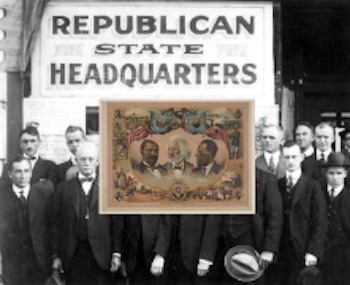
The Black and Tan, and Lily-White (Political Factions), a story
*On this date, 1870, We remember the
Black-and-Tan and the
Lily-White political factions. They were political coalitions in the American Republican Party in the South from the 1870s to the 1960s.
Southern Republicans were divided into two groups: The Lily-white faction, which was practically all-white, and the biracial black-and-tan faction, which replaced the Negro Republican Party faction's name after
Reconstruction in the 1890s. The lily-white lobby was an anti-Black movement within the American Republican Party in the late 19th and early 20th centuries. The alliance responded to the political and socioeconomic gains made by Blacks following the American Civil War and the
Thirteenth Amendment to the Constitution, which abolished slavery.
The Black-and-Tan faction sought to include most Black voters within the party. They often took a prominent part in the national conventions of the Republican party. One reason for the continuance of their faction was its effect in holding the Black Republican vote in northern states. The Black-and-Tans predominated in counties with a large Black population, with the whites in these counties usually being Democrats. Black leaders in Texas and around the country gained increasing influence in the Republican Party by organizing blacks as an important voting bloc via Union Leagues and the biracial Black-and-Tan faction of the Republicans.
Blacks comprised 90% of the party members in Texas during the 1880s. In the South, the Republican Party gradually became known as
"the party of the Negro." The Democratic Party increasingly came to be seen by many in the white community as the party of respectability. The first
Ku Klux Klan targeted violence against Black Republican leaders seriously undercut the Union League. Following the death of Texas Republican leader Edmund J. Davis in 1883, Black civil rights leader
Norris Wright Cuney rose to the Republican chairmanship in Texas, becoming a national committeeman in 1889. While Blacks were a minority overall in Texas, Cuney's rise to this position caused a backlash among white conservative Republicans in other areas, leading to the Lily-whites becoming a more organized, nationwide effort.
The term
lily-white movement was coined by Cuney, who used it in the 1888 Republican convention to describe efforts by white conservatives to oust Blacks from positions of Texas party leadership and incite riots to divide the party. Some authors contend that the effort was coordinated with Democrats as part of a larger movement toward the disenfranchisement of Blacks in the South by increasing restrictions in voter registration rules. The Lilywhites were mostly found in the counties where fewer Blacks lived. Factionalism flared up in 1928 and 1952. The surviving Black-and-Tan factions lost heavily in 1964 and practically disappeared.
*On this date, 1870, we remember the Black-and-Tan and the Lily-White political factions. They were political coalitions in the American Republican Party in the South from the 1870s to the 1960s. Southern Republicans were divided into two groups: The Lily-white faction, which was practically...

aaregistry.org




![relaxing-outside-smiley-emoticon[1].gif](https://www.houseofpolitics.com/data/attachments/21/21807-ccffd1a595c0a39c8872e957727fab51.jpg?hash=WBqjrfX9jP "relaxing-outside-smiley-emoticon[1].gif")