
Stalin
Well-Known Member
- Joined
- Apr 4, 2008
- Messages
- 4,408
Boy, do we have inflation! And we’re not referring merely to yesterday’s +4.2% Y/Y gain on the CPI and today’s +6.5% Y/Y rise in the PPI.
The ultimate inflationary eruption, in fact, is coming squarely at us in tomorrow’s absurd $1.7 trillion IPO of Space X. After all, the relentless central bank monetary inflation of the last several decades did not mainly end up on main street, and it most surely did not disappear silently into the equivalent of a financial black hole.
To the contrary, it flooded into Wall Street and the linked and related asset markets all around the planet, sending valuations soaring into the financial stratosphere.
And we do mean biblical flood of fiat credit. When the Greenspan era got rolling in 1990, the combined balance sheets of the Big Six central banks (Fed, ECB, BOJ, PBOC, BOE and Swiss central bank) totaled $2.0 trillion and represented just 14% of the GDP of their constituent economies.
But after the print-a-thons of the dotcom boom, the Great Financial Crisis of 2008-2009 and the pandemic era eruption of central bank bond-buying, the combined footings of the Big Six central banks stood at $32 trillion and 68% of their constituent GDP by 2022.
To put those gargantuan numbers in perspective, just consider where these balance sheets would have stood by 2022 under Professor Milton Friedman’s 3.0% annual growth of the money supply, based on the correct idea of zero inflation and long-run potential GDP grwoth of about 3.0% per year.
The answer would have been the $2.0 trillion starting point of 1990 would have grown to $5.0 trillion by 2022. So the Big Six central banks along probably generated upwards of $27 trillion of excess central bank credit even under Friedman pro-central bank economic model. And needless to say, that massive excess of cheap, high-powered money ended up in the great financial bubbles of the present era.
As it happens, we have no particular beef against Elon Musk, and believe he has been one of the great capitalist entrepreneurs of the present era—-to say noting of his charitable endeavors, such as rescuing X from the Deep Staters and attempting to shed some DOGE-light on the massive waste in the Federal budget.
But where we do take issue is with the cult following that his business ventures have attained in the Fed-fueled, bubble-ridden financial markets. In the case of Tesla, there is nothing special about his vehicles in a congested, over-supplied EV market that has now slowed down to 5-7% annual growth compared to one-time surges of 20% to 35% a few years ago.
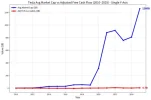
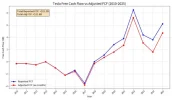
As it happens, however, notwithstanding slumping growth and aggressive competition, ranging from the giant auto industries of China and Japan to the formidable luxury European automakers, Tesla is still trading at this very moment at 305X adjusted free cash flow!
That’s right. Its current market cap of $1.26 trillion dwarfs it adjusted free cash flow into a rounding error. And, to be clear, we are not talking about Tesla’s sales multiple or its so-called PE multiple based on Wall Street’s hideously bloated measures of “adjusted” EPS.

 davidstockman.substack.com
comrade stalin
moscow
The ultimate inflationary eruption, in fact, is coming squarely at us in tomorrow’s absurd $1.7 trillion IPO of Space X. After all, the relentless central bank monetary inflation of the last several decades did not mainly end up on main street, and it most surely did not disappear silently into the equivalent of a financial black hole.
To the contrary, it flooded into Wall Street and the linked and related asset markets all around the planet, sending valuations soaring into the financial stratosphere.
And we do mean biblical flood of fiat credit. When the Greenspan era got rolling in 1990, the combined balance sheets of the Big Six central banks (Fed, ECB, BOJ, PBOC, BOE and Swiss central bank) totaled $2.0 trillion and represented just 14% of the GDP of their constituent economies.
But after the print-a-thons of the dotcom boom, the Great Financial Crisis of 2008-2009 and the pandemic era eruption of central bank bond-buying, the combined footings of the Big Six central banks stood at $32 trillion and 68% of their constituent GDP by 2022.
To put those gargantuan numbers in perspective, just consider where these balance sheets would have stood by 2022 under Professor Milton Friedman’s 3.0% annual growth of the money supply, based on the correct idea of zero inflation and long-run potential GDP grwoth of about 3.0% per year.
The answer would have been the $2.0 trillion starting point of 1990 would have grown to $5.0 trillion by 2022. So the Big Six central banks along probably generated upwards of $27 trillion of excess central bank credit even under Friedman pro-central bank economic model. And needless to say, that massive excess of cheap, high-powered money ended up in the great financial bubbles of the present era.
As it happens, we have no particular beef against Elon Musk, and believe he has been one of the great capitalist entrepreneurs of the present era—-to say noting of his charitable endeavors, such as rescuing X from the Deep Staters and attempting to shed some DOGE-light on the massive waste in the Federal budget.
But where we do take issue is with the cult following that his business ventures have attained in the Fed-fueled, bubble-ridden financial markets. In the case of Tesla, there is nothing special about his vehicles in a congested, over-supplied EV market that has now slowed down to 5-7% annual growth compared to one-time surges of 20% to 35% a few years ago.
As it happens, however, notwithstanding slumping growth and aggressive competition, ranging from the giant auto industries of China and Japan to the formidable luxury European automakers, Tesla is still trading at this very moment at 305X adjusted free cash flow!
That’s right. Its current market cap of $1.26 trillion dwarfs it adjusted free cash flow into a rounding error. And, to be clear, we are not talking about Tesla’s sales multiple or its so-called PE multiple based on Wall Street’s hideously bloated measures of “adjusted” EPS.
Tulip Bulbs In Geostationary Orbit—The Insanity Of Space X’s $1.7 Trillion Valuation
Click on Title to Read
davidstockman.substack.com
comrade stalin
moscow