Had enough of obamanomics?

Are you calling Bush and Greenspan Keynesians?

I am calling those actions Keynesian yes.

The one-time rebate given under Bush, are you calling him a late convert to Keynesian economics?

The near zero interest rates that the fed put in place well before Obama took office-are you calling GREENSPAN a Keynesian? You do realize he sat at the knee of Ayn Rand, right?

I realize no matter they both professed, their actions are all I can look at the make my determinations.

Do you understand the difference between improving a situation and creating a permanent fix?

I do understand such a difference, however the government does not. How often do we hear that a program is "temporary", only to have it last forever?

Do you realize that Obama put far more tax cuts into the first stimulus package than the Keynesians wished, as a compromise measure with the Republicans?

Do you realize that Keynesians have said from the beginning that the problem is that we are dealing in half-measures? A too-small stimulus, and too large a reliance on tax cuts?

I will ask you again, what is "big enough" in your opinion?

Do you realize that WWII spending was a massive economic stimulus?

Do you realize that you are claiming war spending is a massive economic stimulus on one hand, and yet then point to current war spending as a major drain on the economy?

If war spending is stimulus, why is it the Democratic mantra now that Bush's war spending bankrupt the country and caused all the problems?
 
Werbung:
I am calling those actions Keynesian yes.

So there's no economic model that you know of that says that tax cuts are stimulative, other than Keynesian economics?

I realize no matter they both professed, their actions are all I can look at the make my determinations.

So you'd describe keeping interest rates near zero as Keynesian, too?

I do understand such a difference, however the government does not. How often do we hear that a program is "temporary", only to have it last forever?

That is a canard, not an argument.

I will ask you again, what is "big enough" in your opinion?

I gave you Krugman's article. You can't expect me to give you dollars and cents. We are two people on a discussion board. Geez.

Do you realize that you are claiming war spending is a massive economic stimulus on one hand, and yet then point to current war spending as a major drain on the economy?

Well, no, I'm not. War spending is a stimulus. And current war spending has led to a deficit.

If war spending is stimulus, why is it the Democratic mantra now that Bush's war spending bankrupt the country and caused all the problems?

I don't think you've followed their arguments particularly well. It is a stimulus. It also contributes to the deficit. No one said that it "caused all the problems", whatever that means.
 
What a revelation that is..............spending money on wars causes economic stimulus and also causes budget deficits. I did not know that. Thanks for the info!
 
What a revelation that is..............spending money on wars causes economic stimulus and also causes budget deficits. I did not know that. Thanks for the info!

I have not really examined the war spending in detail. But it seems like the piddly little wars are enough to be a drain on the budget, but not enough to really cause economic stimulus.

To be fair, I am sure a dollar spent for military equipment helps give someone a job, and the person earning that dollar in turn will spend it to buy food or whatever (ie, multiplier effect). Also, no question that "hiring" soldiers holds down unemployment - a rather gruesome way to keep people employed.

On the other hand, as a percent of spending, spending on these wars is probably a relatively small percentage of the defense budget (which is already pretty bloated).

I know WWII stands out as the classic model of war spending causing bringing us out of the depression. However, this was a LOT of new spending versus a relatively small amount of old spending that we have now. The stimulus caused by the war on terror had its impact in the early part of the century. Now, that is just maintenance money to keep some people employed in a bad economy.

Defense spending hurts the federal deficit through a thousand cuts. As Sec. Def. Gates has found out, you can cut here and cut there, but at the end of the day very little money is saved. IMO, the only way to really cut defense spending (which is 1/3 of the federal spending) is to demand a cross the board cut of say 10% or even 20%.

Government bureaucracies tend to grow old and fat. It is hard for a commission or a committee to identify the location of each bit of fat. Much of it is tied up in some useless program that just never got eliminated, or having 15 people do the work when only 10 people could do an equally good job.

I recall in 1970 and in later years the DoD would send out a message to all commands, "But military staff by 10%". Just that easy. Suddenly the aircraft carrier I was on had 4500 men where previously it had 5000. The communications department had 9 people per shift, rather than 10. I saw no practical difference... I guess we all picked up the pace of work a little bit. Not a huge strain because we were all still working at a snails pace.
 
It's too arbitrary to be smart, IMO, to just throw percentages around. You're right, people do pick up what's left undone, but often at the expense of doing a good job.
 
It's too arbitrary to be smart, IMO, to just throw percentages around. You're right, people do pick up what's left undone, but often at the expense of doing a good job.

You only have to look at President Obama's bipartisan National Commission on Fiscal Responsibility and Reform to see that a reasoned approach is never going to work in Washington. Ha, show me a bureaucrat that would be overworked if the workload were increased 10%! No such animal. They work in the government because they are lazy at heart.
 
You can't really believe that.

Have you ever had a course in Business Administration? One of the fundamental principles of management is a stagnant organization will naturally become inefficient.

I had a policy in my engineering company that the best offices were given to the best performers, regardless of how long they had been with the company. The marginal performers got a bad office, and poor performers got fired. I have fired a lot of people in my life because they were poor performers.

Later in life, I was a Public Works Engineer for a city. I had a man working for me who was such a slow worker that he was virtually useless. I tried like hell to get him fired and discovered it was impossible. He had longevity, was protected by the union, and State law made it impossible for him to be fired.

Now which of these two organizations do you think were more efficient? Having one lazy man who occupies a chair and desk plus pulls down a salary should tell you the answer. If you work for government you know what I say is true. Plus one person like that ruins the motivation and morale of the rest of the staff.

Eventually a new City Manager was hired who worked with the City Council to make city government more efficient. He accomplished this by completely reorganizing the entire organization chart. The Parks Department was consolidated under the Engineering Department, etc, etc. Many job descriptions were changed and some of the work (like street maintenance) was contracted out to private companies.

This wholesale re-organization allowed management to get rid of the dead wood and make the entire City much more efficient.

A top to bottom cut of 10% of the Federal government would both save money and allow government to become a lot more efficient. Wouldn't you love to call a government agency and have a real-life operator answer your call immediately? That is quite possible when you allow American managers to do their job.
 
Had enough of obamanomics?

July 14, 2011

"Voters are increasingly displeased with President Obama's handling of the economy, but a new poll finds most Americans still think George W. Bush is responsible for the nation's dismal financial state.

According to a new Quinnipiac poll, 54 percent of those surveyed say Bush is responsible for the "current condition" of the economy, compared to just 27 percent who blame Obama. Among self-described independent voters, a key 2012 voting bloc, the number shifts slightly: 49 percent point the finger at the former GOP president, while 24 percent blame Obama."


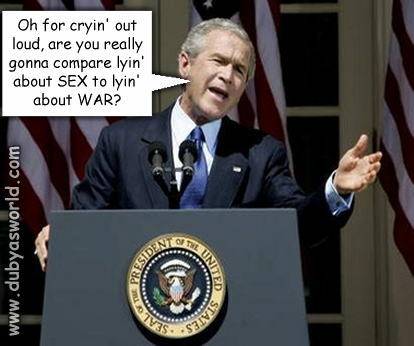
crying-loud.jpg
 
What a revelation that is..............spending money on wars causes economic stimulus and also causes budget deficits. I did not know that. Thanks for the info!

Yes, foreing wars are a cause of GREAT economic stimulus. . .in foreign nations!

They are the cause of budget deficits at home.

But mostly, they are the cause of Americans dying for "made up" causes that only benefit the international defense industry!
 
Werbung:
Back
Top