Islam is not "ungodly": Muslims are told in all sects of Islam to pray to God five times per day, reminding God that he is great and there is just one of him.
Marx taught that religion is the opiate of the masses, a myth used to prevent the working class from rising up and taking over the governments and monopolists that oppress them.
Capitalism, again, is NOT a political system of government, but a tool that is used to amass capital from numerous smaller investors to build companies for the purpose of producing profit. It is the tool used very ably by the Chinese Communist Party to create the second largest economy on this planet in a very short period.
The political system used in the US is essentially corporatism, which favors larger investors over smaller ones.
Islam is not "ungodly": Muslims are told in all sects of Islam to pray to God five times per day, reminding God that he is great and there is just one of him.
Marx taught that religion is the opiate of the masses, a myth used to prevent the working class from rising up and taking over the governments and monopolists that oppress them.
Capitalism, again, is NOT a political system of government, but a tool that is used to amass capital from numerous smaller investors to build companies for the purpose of producing profit. It is the tool used very ably by the Chinese Communist Party to create the second largest economy on this planet in a very short period.
The political system used in the US is essentially corporatism, which favors larger investors over smaller ones.
Lately, losing one’s head for Islam has most appropriately referred to livid, murderous mobs in Afghanistan and Pakistan who, unfortunately, took at face value Newsweek and its false story of American interrogators’ desecration of the Qur’an at Gitmo. Lest we forget, however—since it hasn’t...
www.historynewsnetwork.org
Lately, losing one’s head for Islam has most appropriately referred to livid, murderous mobs in Afghanistan and Pakistan who, unfortunately, took at face value Newsweek and its false story of American interrogators’ desecration of the Qur’an at Gitmo. Lest we forget, however—since it hasn’t happened for some months—there is a much more literal and horrific sense in which someone can lose his head for Islam, particularly if he is non-Muslim. Between the spring of 2003 and the fall of 2004, dozens (mostly non-Muslim, but also some Turks and at least one Egyptian) were decapitated in Iraq and Saudi Arabia by Islamists. Perhaps we have seen the last of such brutality. But more than likely, we have not—for beheading has a long pedigree in Islam, both religious and historical.
For the last several years, commentators (both Muslim and non-Muslim) have tried to whitewash decapitation, claiming either that it was un-Qur’anic1 or that it was a misrepresentation of Islam2 (or both). Western, particularly American, journalists have seized on these pronouncements and disseminated them willy-nilly, never stopping to actually check them against the Qur’an and against Islamic history. Doing so reveals the vacuuity—indeed, the outright mendacity—of the claims that beheading is unIslamic.
Karl Henrich Marx and Allama Iqbal are the two most illustrious philosophers. In Javednama Iqbal generously praises Marx, giving him the highest status that a person could aspire to, short of prophethood. “He is not a prophet but he holds a book
meanwhile, back at the topic, it seems the hapless orban, having made a pig's breakfast of the hungarian economy, is
relying of the strange antics of his hopeless hero horace q frump
After 16 years of uninterrupted power, Viktor Orbán is facing his biggest electoral challenge. For years Hungary’s prime minister has spun weak policy performance as success. The rise of a rival, Péter Magyar, and the opposition Tisza party has exposed the limits of that strategy.
The economy is stagnating, despite repeated promises of a long-awaited takeoff. Over the past decade and a half, Hungary has slipped from being one of central and eastern Europe’s strongest performers to one of its weakest. Public services, from healthcare to transport, are widely seen as neglected, and Policy Solutions surveys show that voters have noticed. Hungary is not alone in facing a cost of living crisis, but comparisons offer little consolation to voters who were assured that Orbán’s model would deliver exceptional results.
Tisza has unified a previously fragmented opposition and turned the April 12 parliamentary election into a genuine contest. At this stage, nearly half of Hungarians say they want a change of government.
Yet preference is not the same as confidence. Many voters still doubt that change is within reach. This tension between dissatisfaction with the status quo and nervousness about the feasibility of political change has created an unpredictable electoral landscape. Frustration with Orbán may not be sufficient to overcome fear of the unknown.
Orbán also has something his rival can’t match: he has a tailwind from Washington. While he may have little to shout about at home, Orbán has gained new momentum in Donald Trump’s volatile second term.
Orbán’s campaign narrative now rests on the boast that he is simultaneously on good terms with the leaders of the United States, Russia and China. In a world of strongmen, Hungary needs a leader who can sit at their table.
Expect Trump’s name to feature increasingly in the campaign as Orbán seeks to reinforce the claim that he – and only he – has the ear of the world’s most powerful leaders. His recent White House audience was proof of international relevance and this weekend’s visit of Marco Rubio to Budapest will only reinforce that narrative.
What is striking about this campaign is that Fidesz, Orbán’s party, is no longer asking voters to reward it for a record of good governance. Rather, it is warning people that however dissatisfied they may be, Hungary could be a lot worse off. The aim is not to mobilise hope, but to suppress it – to make sure voters see the ballot box not as an opportunity for change, but as a risk
"First they came for the socialists, and I did not speak out—because I was not a socialist. Then they came for the trade unionists, and I did not speak out—because I was not a trade unionist. Then they came for the Jews, and I did not speak out—because I was not a Jew. Then they came for me—and there was no one left to speak for me." — Martin Niemöller.
First they came for the Communists
And I did not speak out
Because I was not a Communist
Then they came for the Socialists
And I did not speak out
Because I was not a Socialist
Then they came for the trade unionists
And I did not speak out
Because I was not a trade unionist
Then they came for the Jews
And I did not speak out
Because I was not a Jew
Then they came for me
And there was no one left
To speak out for me
meanwhile, back at the topic, it seems the hapless orban, having made a pig's breakfast of the hungarian economy, is
relying of the strange antics of his hopeless hero horace q frump
After 16 years of uninterrupted power, Viktor Orbán is facing his biggest electoral challenge. For years Hungary’s prime minister has spun weak policy performance as success. The rise of a rival, Péter Magyar, and the opposition Tisza party has exposed the limits of that strategy.
The economy is stagnating, despite repeated promises of a long-awaited takeoff. Over the past decade and a half, Hungary has slipped from being one of central and eastern Europe’s strongest performers to one of its weakest. Public services, from healthcare to transport, are widely seen as neglected, and Policy Solutions surveys show that voters have noticed. Hungary is not alone in facing a cost of living crisis, but comparisons offer little consolation to voters who were assured that Orbán’s model would deliver exceptional results.
Tisza has unified a previously fragmented opposition and turned the April 12 parliamentary election into a genuine contest. At this stage, nearly half of Hungarians say they want a change of government.
Yet preference is not the same as confidence. Many voters still doubt that change is within reach. This tension between dissatisfaction with the status quo and nervousness about the feasibility of political change has created an unpredictable electoral landscape. Frustration with Orbán may not be sufficient to overcome fear of the unknown.
Orbán also has something his rival can’t match: he has a tailwind from Washington. While he may have little to shout about at home, Orbán has gained new momentum in Donald Trump’s volatile second term.
Orbán’s campaign narrative now rests on the boast that he is simultaneously on good terms with the leaders of the United States, Russia and China. In a world of strongmen, Hungary needs a leader who can sit at their table.
Expect Trump’s name to feature increasingly in the campaign as Orbán seeks to reinforce the claim that he – and only he – has the ear of the world’s most powerful leaders. His recent White House audience was proof of international relevance and this weekend’s visit of Marco Rubio to Budapest will only reinforce that narrative.
What is striking about this campaign is that Fidesz, Orbán’s party, is no longer asking voters to reward it for a record of good governance. Rather, it is warning people that however dissatisfied they may be, Hungary could be a lot worse off. The aim is not to mobilise hope, but to suppress it – to make sure voters see the ballot box not as an opportunity for change, but as a risk
It is not illegal to be a Marxist or a Muslim. Everyone who voted for him did do because they are being exploited by real estate shysters, slumlords and corrupt billionaires.
We enjoy freedom of religion and freedom of thought in our country, which is as it should be.
It is not illegal to be a Marxist or a Muslim. Everyone who voted for him did do because they are being exploited by real estate shysters, slumlords and corrupt billionaires.
We enjoy freedom of religion and freedom of thought in our country, which is as it should be.
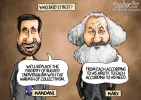
Mamdani's solution to people being exploited by slumlords and billionaires is to drive billionaires out of town and shut down real estate development. That is pure Marxism but is also pure stupidity.
Mamdani's solution to people being exploited by slumlords and billionaires is to drive billionaires out of town and shut down real estate development. That is pure Marxism but is also pure stupidity.
This site uses cookies to help personalise content, tailor your experience and to keep you logged in if you register.
By continuing to use this site, you are consenting to our use of cookies.