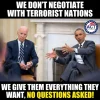
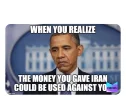
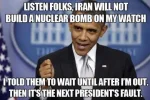
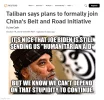
It's going soooo well...

Werbung:

Obama Bribed Iran $400 Million to Release U.S. Prisoners?​


theTrumpet.com


trumpet_brief_logo_wide-11735725d09ce8c2095dc139c2fe59ae6ed6a0cb3c0c05faa4b840b6ee7e7481.svg

Receive a free news briefing in your inbox each weekday—the Trumpet Brief.

locus_15428.jpg.jpg

America’s History of Paying Ransom to Iran​

Getty Images
President Obama wasn’t the first to offer Iran money in exchange for hostages.
By Sam Livingston • December 6, 2016


On the morning of Jan. 16, 1981, United States President Jimmy Carter sat down with his advisers to discuss one last proposition to get 52 American hostages out of Iran. Carter had four days left in office after he lost his reelection bid, which was largely blamed on how he handled the Iran hostage crisis.

The subject of Carter’s January 16 meeting was an Iranian proposition made the day before. Carter recorded the details in his White House diary:

The Iranians made a good proposition to us yesterday based on transferring $8.1 billion to the Bank of England. They would then refund all except about $3 billion of it, release the hostages immediately, and solve the rest of the disputes over interest rates and claims through normal processes in the future.
That day, Carter got the ball rolling on an exchange when he made the decision to unfreeze Iranian gold and bank assets and transfer them into an escrow account at the Bank of England.
 
"The benchmark S&P 500 was flat on Monday as gains in technology stocks offset broader market losses stemming from worries that a prolonged Middle East conflict could ‌disrupt global trade routes and reignite inflationary pressures.
.
Sectors that were
hit the most included airlines, as a number of carriers halted flights, while several oil and gas facilities in the Middle East stopped production, which pushed crude prices up over 8%."
.
 
Last edited:
Werbung:

Obama Bribed Iran $400 Million to Release U.S. Prisoners?​


theTrumpet.com


trumpet_brief_logo_wide-11735725d09ce8c2095dc139c2fe59ae6ed6a0cb3c0c05faa4b840b6ee7e7481.svg

Receive a free news briefing in your inbox each weekday—the Trumpet Brief.

locus_15428.jpg.jpg

America’s History of Paying Ransom to Iran​

Getty Images
President Obama wasn’t the first to offer Iran money in exchange for hostages.
By Sam Livingston • December 6, 2016


On the morning of Jan. 16, 1981, United States President Jimmy Carter sat down with his advisers to discuss one last proposition to get 52 American hostages out of Iran. Carter had four days left in office after he lost his reelection bid, which was largely blamed on how he handled the Iran hostage crisis.

The subject of Carter’s January 16 meeting was an Iranian proposition made the day before. Carter recorded the details in his White House diary:


That day, Carter got the ball rolling on an exchange when he made the decision to unfreeze Iranian gold and bank assets and transfer them into an escrow account at the Bank of England.


..er..it was the republican reagan that actually PAID the money..pu yay in your pipe and smoke it

do better

"..The latest victim in the presidential race’s assault on truth — to say nothing of nuance — came last week in the flurry of accusations surrounding the United States’ payment of $400 million to Iran. Donald Trump called it ransom, and Sen. Tom Cotton (R-Ark.) accused the United States of acting like a “drug cartel.”

In reality, the payment represented continued adherence to a masterful feat of American diplomacy and to the peaceful resolution of disputes under international law. Ronald Reagan understood how important it is for us to keep our promises — which is why, as president, he upheld the agreement negotiated by the Carter administration that led to the recent payment.

The payment was not a ransom but rather part of a settlement agreement that the United States reached with Iran for claims arising out of the 1979 Iranian revolution, which toppled the pro-American shah and brought the current Islamist government to power. Before the revolution, the United States had signed hundreds of contracts with Iran, then an ally, to sell it military equipment. When the hostile Islamist regime took power, the military sales relationship collapsed. That left hundreds of millions of dollars of outstanding claims between the two countries and their citizens: claims both by U.S. companies for breached contracts and expropriated properties, and Iranian demands for the delivery or return of equipment that Iran had already paid for but not received — not to mention the issue of the 52 Americans that Iran then held hostage.


plus, the egregious reagan actually SOLD ARMS TO IRAN for which several apparatchiks were prosecuted


comrade stalin
 
Back
Top