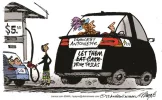
As cars get more gas millage politicians find ways to raise taxes on you for it .

They didn't have to prove it because fox was afraid of the trial where they would prove it. Lol

Fox knew they lied. Pretrial discovery showed it for all to see
In spite of all the denials Dominion still forbids examiners from examining their voting machines that cranked out miraculously high numbers of votes for Biden in 2020 and strangely lowered numbers of votes for Trump.

https://centralcitynews.us/wp-content/uploads/2020/11/Central-City-News-11-19-20-Small.pdf

How Election Was StolenThe Scandal of the CenturyAnalysis ShowsObvious Fraud By Computer inStates of GA, PA
 
Werbung:
Are oil companies evil for making profits? If Democrats think that then why do so many invest in oil companies? Oil companies make billions in profits some years and lose billions in other years, yet the average profit made by oil companies remains at higher than 2% and lower than 3% of total receipts. Clean energy companies are making closer to 10-12% profit. Does that make green energy companies more wicked than oil companies, or are some companies not evil for making profits while others are evil for making profits?

Democrats in Congress Are Pumping Big Money Into Fossil-Fuel Stocks (businessinsider.com)

22 Democrats hailed as environmental champions have personally pumped money into companies that rely on fossil fuels
 
In spite of all the denials Dominion still forbids examiners from examining their voting machines that cranked out miraculously high numbers of votes for Biden in 2020 and strangely lowered numbers of votes for Trump.

https://centralcitynews.us/wp-content/uploads/2020/11/Central-City-News-11-19-20-Small.pdf

How Election Was StolenThe Scandal of the CenturyAnalysis ShowsObvious Fraud By Computer inStates of GA, PA

dominion doesn't control machines, *****, they can't "forbid" anyone.

and your "evidence" was so stupid you couldn't even convince trump judges. lol

god you're stupid. lol
 
dominion doesn't control machines, *****, they can't "forbid" anyone.

and your "evidence" was so stupid you couldn't even convince trump judges. lol

god you're stupid. lol
You fail to understand all the aspects of the discussion about voting machines. States may own the machines but Democrats strictly control who can examine them and how the examinations are to be conducted. Dominion does not have to allow audits of its computer operations at all if it does not want to.

Trade secret law makes it impossible to independently verify that voting machines work properly. (slate.com)

The risk of the theft (known in trade secret parlance as misappropriation) of trade secrets—generally defined as information that derives economic value from not being known by competitors, like the formula for Coca-Cola—is a serious issue. But should the “special sauce” found in voting machines really be treated the same way as Coca-Cola’s recipe? Do we want the source code that tells the machine how to register, count, and tabulate votes to be a trade secret such that the public cannot verify that an election has been conducted accurately and fairly without resorting to (ironically) paper verification? Can we trust the private vendors when they assure us that the votes will be assigned to the right candidate and won’t be double-counted or simply disappear, and that the machines can’t be hacked? As a September USA Today editorial described, all of the above have either been proven to be potential risks or have actually happened.

Nonetheless, primarily because of trade secret law, the policy answer to the above questions is an unqualified “yes.” Undoubtedly, voting machine companies, just like telecommunications companies, have legitimate secrets, and they have the right to protect those secrets against misappropriation. But the legitimate use of trade secrecy by voting machine companies also means that the public has no way to independently verify that the machines are working properly. The public has been stripped of its ability to have independent, verifiable confidence that when a vote is made, it will be tabulated and recorded properly. Trade secret law means that we must trust the vendors when they say that their machines are free of error, bias, flaws, and security loopholes. Trade secret law effectively means that independent researchers who want to test voting machines and assure that they are operating properly cannot do so without the permission of the vendor—or risk being found to have misappropriated the trade secrets themselves.
 
You fail to understand all the aspects of the discussion about voting machines. States may own the machines but Democrats strictly control who can examine them and how the examinations are to be conducted. Dominion does not have to allow audits of its computer operations at all if it does not want to.

Trade secret law makes it impossible to independently verify that voting machines work properly. (slate.com)

The risk of the theft (known in trade secret parlance as misappropriation) of trade secrets—generally defined as information that derives economic value from not being known by competitors, like the formula for Coca-Cola—is a serious issue. But should the “special sauce” found in voting machines really be treated the same way as Coca-Cola’s recipe? Do we want the source code that tells the machine how to register, count, and tabulate votes to be a trade secret such that the public cannot verify that an election has been conducted accurately and fairly without resorting to (ironically) paper verification? Can we trust the private vendors when they assure us that the votes will be assigned to the right candidate and won’t be double-counted or simply disappear, and that the machines can’t be hacked? As a September USA Today editorial described, all of the above have either been proven to be potential risks or have actually happened.

Nonetheless, primarily because of trade secret law, the policy answer to the above questions is an unqualified “yes.” Undoubtedly, voting machine companies, just like telecommunications companies, have legitimate secrets, and they have the right to protect those secrets against misappropriation. But the legitimate use of trade secrecy by voting machine companies also means that the public has no way to independently verify that the machines are working properly. The public has been stripped of its ability to have independent, verifiable confidence that when a vote is made, it will be tabulated and recorded properly. Trade secret law means that we must trust the vendors when they say that their machines are free of error, bias, flaws, and security loopholes. Trade secret law effectively means that independent researchers who want to test voting machines and assure that they are operating properly cannot do so without the permission of the vendor—or risk being found to have misappropriated the trade secrets themselves.

nope, democrats do not "strictly control" who can examine them, *****.
machines in red states aren't controlled by democrats, for example, and judges can order them to be examined even in blue states.


Maricopa County’s election equipment and software passed all tests performed by two independent firms hired to conduct the forensic audit, according to reports by two federally certified Voting System Testing Laboratories.

forensic auditors are ok with how dominion machines worked there.

god your'e stupid. lol
 
You fail to understand all the aspects of the discussion about voting machines. States may own the machines but Democrats strictly control who can examine them and how the examinations are to be conducted. Dominion does not have to allow audits of its computer operations at all if it does not want to.

Trade secret law makes it impossible to independently verify that voting machines work properly. (slate.com)

The risk of the theft (known in trade secret parlance as misappropriation) of trade secrets—generally defined as information that derives economic value from not being known by competitors, like the formula for Coca-Cola—is a serious issue. But should the “special sauce” found in voting machines really be treated the same way as Coca-Cola’s recipe? Do we want the source code that tells the machine how to register, count, and tabulate votes to be a trade secret such that the public cannot verify that an election has been conducted accurately and fairly without resorting to (ironically) paper verification? Can we trust the private vendors when they assure us that the votes will be assigned to the right candidate and won’t be double-counted or simply disappear, and that the machines can’t be hacked? As a September USA Today editorial described, all of the above have either been proven to be potential risks or have actually happened.

Nonetheless, primarily because of trade secret law, the policy answer to the above questions is an unqualified “yes.” Undoubtedly, voting machine companies, just like telecommunications companies, have legitimate secrets, and they have the right to protect those secrets against misappropriation. But the legitimate use of trade secrecy by voting machine companies also means that the public has no way to independently verify that the machines are working properly. The public has been stripped of its ability to have independent, verifiable confidence that when a vote is made, it will be tabulated and recorded properly. Trade secret law means that we must trust the vendors when they say that their machines are free of error, bias, flaws, and security loopholes. Trade secret law effectively means that independent researchers who want to test voting machines and assure that they are operating properly cannot do so without the permission of the vendor—or risk being found to have misappropriated the trade secrets themselves.

if your argument is that we don't know the "true' results of ANY election, including trump's in 2016, well that's a different one.
I won't argue that it is theoretically possible, along with the possibility that space aliens are controlling our minds. duh
 
You fail to understand all the aspects of the discussion about voting machines. States may own the machines but Democrats strictly control who can examine them and how the examinations are to be conducted. Dominion does not have to allow audits of its computer operations at all if it does not want to.

Trade secret law makes it impossible to independently verify that voting machines work properly. (slate.com)

The risk of the theft (known in trade secret parlance as misappropriation) of trade secrets—generally defined as information that derives economic value from not being known by competitors, like the formula for Coca-Cola—is a serious issue. But should the “special sauce” found in voting machines really be treated the same way as Coca-Cola’s recipe? Do we want the source code that tells the machine how to register, count, and tabulate votes to be a trade secret such that the public cannot verify that an election has been conducted accurately and fairly without resorting to (ironically) paper verification? Can we trust the private vendors when they assure us that the votes will be assigned to the right candidate and won’t be double-counted or simply disappear, and that the machines can’t be hacked? As a September USA Today editorial described, all of the above have either been proven to be potential risks or have actually happened.

Nonetheless, primarily because of trade secret law, the policy answer to the above questions is an unqualified “yes.” Undoubtedly, voting machine companies, just like telecommunications companies, have legitimate secrets, and they have the right to protect those secrets against misappropriation. But the legitimate use of trade secrecy by voting machine companies also means that the public has no way to independently verify that the machines are working properly. The public has been stripped of its ability to have independent, verifiable confidence that when a vote is made, it will be tabulated and recorded properly. Trade secret law means that we must trust the vendors when they say that their machines are free of error, bias, flaws, and security loopholes. Trade secret law effectively means that independent researchers who want to test voting machines and assure that they are operating properly cannot do so without the permission of the vendor—or risk being found to have misappropriated the trade secrets themselves.
Same old shit. Everything is stacked against the godbothering right. Those bloody communists again. Was it them that awarded Trump the 2016 and you never belated a word. How coincidental you hypocrite.
 
Werbung:
nope, democrats do not "strictly control" who can examine them, *****.
machines in red states aren't controlled by democrats, for example, and judges can order them to be examined even in blue states.


Maricopa County’s election equipment and software passed all tests performed by two independent firms hired to conduct the forensic audit, according to reports by two federally certified Voting System Testing Laboratories.

forensic auditors are ok with how dominion machines worked there.

god your'e stupid. lol
You do not prove Dominion machines are not blocked from certain investigative depths and measures due to proprietary claims. Dominion's rules guarding the secrecy of processes and info produced on Dominion machines during an election:

Article: A Guide for Protecting Proprietary Information – Dominion General Counsel, PC (dominiongc.com)

Like most all modern companies, your company (“Company”) and its staff face tremendous market pressure to protect the trade secrets and confidential information belonging to the Company, its customers and its collaborators. Successful protection of confidential information allows the Company to keep staff employed, grow staff opportunities, serve existing customers, and attract new customers.

The Company’s confidential information falls into two main categories: a) information developed and owned by Company; and b) information temporarily given to Company by its customers, collaborators and others. This guide deals with both categories.

Every Company team member, whether a manager, employee or contractor, has a key role in maintaining the Company’s confidential information. This Guide is intended to help Company team members better understand how to maximize the protections of sensitive information while reducing risks of inadvertent disclosure. For purposes of this article, trade secrets are treated like confidential information.

Once disclosed publicly (or in the absence of a confidential obligation), the “confidential” nature of a piece of information is lost forever. The inadvertent disclosure of sensitive information can permanently eliminate the ability to maintain or control the secrecy in the information.

III. EXAMPLES OF CONFIDENTIAL INFORMATION

The confidential information covers many types of information. Generally, confidential information includes any secret information that gives the Company a competitive advantage.

If a staff member is unable to determine whether information is confidential, the staff member should assume the item is confidential until otherwise confirmed by Company management. Examples of confidential information might include:

Company information marked “Confidential”.

Company customer targets and proposals.

Software application designs and specifications.

Details contained in signed contracts.

The dimensions, staff numbers and resources located in an office location.

Project status updates and reports.

Business plans.

Company databases.

Company pricing programs.

Company strategic plans.

Company financial records.

Employee files, compensation and benefits.

Company research and development projects.

Company marketing strategies and programs.

Company’s new customer targets.

Company’s new business development initiatives.

Company reports and analysis.

Contract and negotiation strategies.

Company processes, techniques and systems used or considered for use.

Hardware, software, and database passwords.

Software code created for a Customer.

Customer information (and any third party items) marked as “Confidential”.

Customer systems and databases.

Customer business, financial and sales data.


Anyone seeking to examine the security logs or images produced on Dominion machines during an election faces possible fines and jail time for violating their government-protected propriety protections. In other words, when Dominion machines are used examinations of the machines afterward for evidence of fraud is not possible.
 
Back
Top